|
Social Network Analysis: An Introduction
|
Social network analysis [SNA] is the mapping and measuring of relationships and flows between people, groups, organizations, computers, URLs, and other connected information/knowledge entities. The nodes in the network are the people and groups while the links show relationships or flows between the nodes. SNA provides both a visual and a mathematical analysis of human relationships. Management consultants use this methodology with their business clients and call it Organizational Network Analysis [ONA]. ONA allows you to x-ray your organization and reveal the managerial nervous system that connects everything. To understand networks and their participants, we evaluate the location and grouping of actors in the network. These measures give us insight into the various roles and groupings in a network -- who are the connectors, mavens, leaders, bridges, isolates, where are the clusters and who is in them, who is in the core of the network, and who is on the periphery?
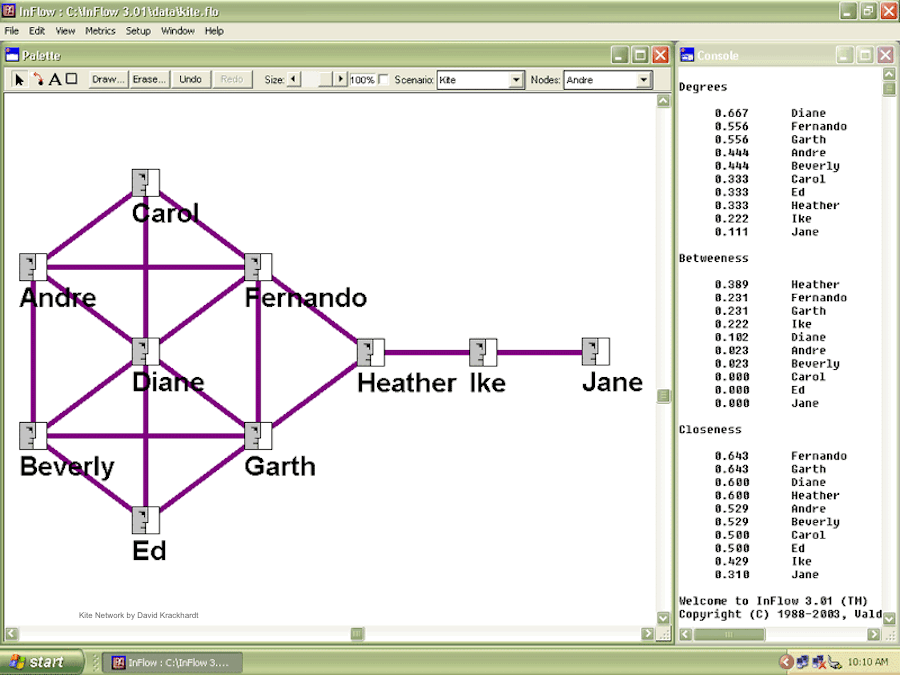
We look at a social network -- the "Kite Network" above -- developed by David Krackhardt, a leading researcher in social networks. Two nodes are connected if they regularly talk to each other, or interact in some way. Andre regularly interacts with Carol, but not with Ike. Therefore Andre and Carol are connected, but there is no link drawn between Andre and Ike. This network effectively shows the distinction between the three most popular individual centrality measures: Degree Centrality, Betweenness Centrality, and Closeness Centrality. Degree CentralitySocial network researchers measure network activity for a node by using the concept of degrees -- the number of direct connections a node has. In the kite network above, Diane has the most direct connections in the network, making hers the most active node in the network. She is a \'connector\' or \'hub\' in this network. Common wisdom in personal networks is "the more connections, the better." This is not always so. What really matters is where those connections lead to -- and how they connect the otherwise unconnected! Here Diane has connections only to others in her immediate cluster -- her clique. She connects only those who are already connected to each other. Betweenness CentralityWhile Diane has many direct ties, Heather has few direct connections -- fewer than the average in the network. Yet, in may ways, she has one of the best locations in the network -- she is between two important constituencies. She plays a \'broker\' role in the network. The good news is that she plays a powerful role in the network, the bad news is that she is a single point of failure. Without her, Ike and Jane would be cut off from information and knowledge in Diane\'s cluster. A node with high betweenness has great influence over what flows -- and does not -- in the network. Heather may control the outcomes in a network. That is why I say, "As in Real Estate, the golden rule of networks is: Location, Location, Location." Closeness CentralityFernando and Garth have fewer connections than Diane, yet the pattern of their direct and indirect ties allow them to access all the nodes in the network more quickly than anyone else. They have the shortest paths to all others -- they are close to everyone else. They are in an excellent position to monitor the information flow in the network -- they have the best visibility into what is happening in the network. Network CentralizationIndividual network centralities provide insight into the individual\'s location in the network. The relationship between the centralities of all nodes can reveal much about the overall network structure. A very centralized network is dominated by one or a few very central nodes. If these nodes are removed or damaged, the network quickly fragments into unconnected sub-networks. A highly central node can become a single point of failure. A network centralized around a well connected hub can fail abruptly if that hub is disabled or removed. Hubs are nodes with high degree and betweeness centrality. A less centralized network has no single points of failure. It is resilient in the face of many intentional attacks or random failures -- many nodes or links can fail while allowing the remaining nodes to still reach each other over other network paths. Networks of low centralization fail gracefully. Network ReachNot all network paths are created equal. More and more research shows that the shorter paths in the network are more important. Noah Friedkin, Ron Burt and other researchers have shown that networks have horizons over which we cannot see, nor influence. They propose that the key paths in networks are 1 and 2 steps and on rare occasions, three steps. The "small world" in which we live is not one of "six degrees of separation" but of direct and indirect connections < 3 steps away. Therefore, it is important to know: who is in your network neighborhood? Who are you aware of, and who can you reach? In the network above, who is the only person that can reach everyone else in two steps or less? Network IntegrationNetwork metrics are often measured using geodesics -- or shortest paths. They make the (erroneous) assumption that all information/influence flows along the network\'s shortest paths only. But networks operate via direct and indirect, shortest and near-shortest paths. We often hear interesting things from various sources in the network. Different interpretations arrive via different paths. Therefore, it is important to be on many efficient paths in networks that reach out to various parts of the extended network. Those well integrated in the network of paths have both local and distant information, along with several flavors of it! Boundary SpannersNodes that connect their group to others usually end up with high network metrics. Boundary spanners such as Fernando, Garth, and Heather are more central in the overall network than their immediate neighbors whose connections are only local, within their immediate cluster. You can be a boundary spanner via your bridging connections to other clusters or via your concurrent membership in overlappping groups. Boundary spanners are well-positioned to be innovators, since they have access to ideas and information flowing in other clusters. They are in a position to combine different ideas and knowledge, found in various places, into new products and services. Peripheral PlayersMost people would view the nodes on the periphery of a network as not being very important. In fact, Ike and Jane receive very low centrality scores for this network. Since individuals\' networks overlap, peripheral nodes are connected to networks that are not currently mapped. Ike and Jane may be contractors or vendors that have their own network outside of the company -- making them very important resources for fresh information not available inside the company! Client FeedbackWhen sharing network maps and metrics with clients I explain to them that the maps and metrics are mirrors, not report cards! The consultant and the client together make sense of what the maps/metrics reflect about the organization. The consultant brings external expertise and context, while the client provides internal context about the organizations and its goals. Both are necessary to analyze the networks properly! Before sharing the actual network visualizations, I introduce the client to what s/he will see via the Network Discovery Matrix. |